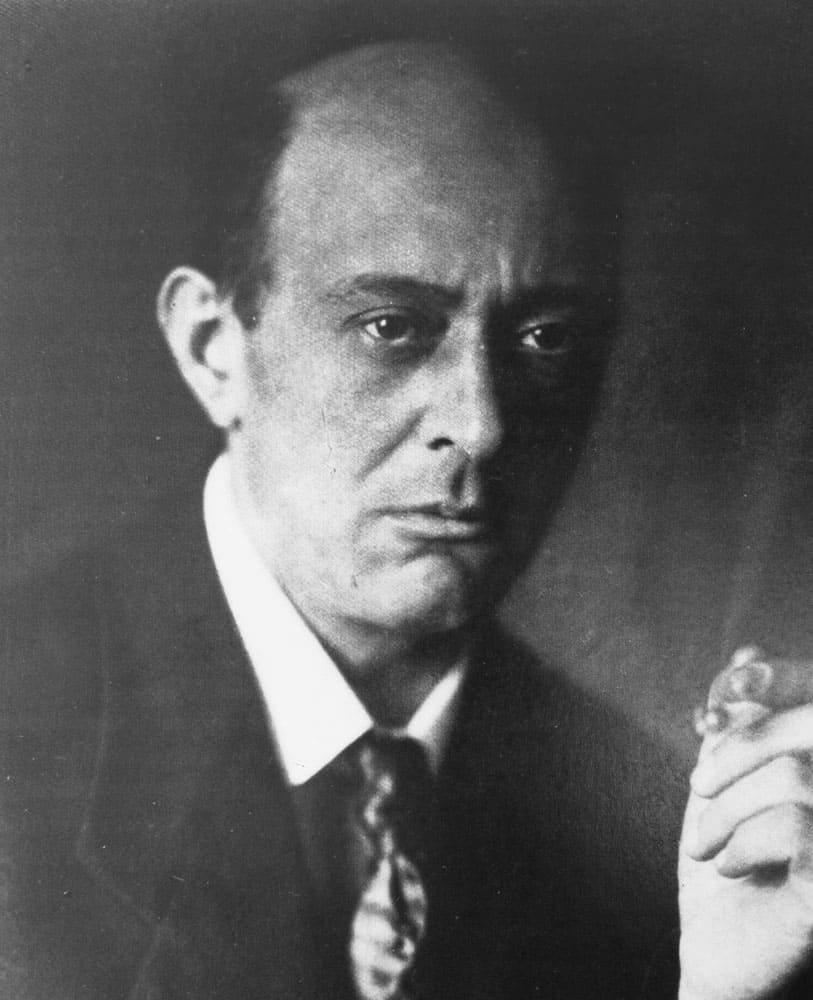
Crisis and innovation in song compositions
by Arnold Schoenberg, Robert Schumann and Gustav Mahler
At the opening of Arnold Schoenberg’s song cycle "Fünfzehn Gedichte aus 'Das Buch der hängenden Gärten' op.15" ("Fifteen Poems from 'The Book of the Hanging Gardens' op.15"), a low piano voice ventures hesitantly and alone into an open, as of yet uncharted sound space, unmoored from tonality, unsettled by syncopation and reaching for orientation amidst constant changes in direction. At once inhibited and driven, the searching motion of this solitary subject fills the void with tension, expanding until it reaches a provisional point of rest. A glance back towards the distant point of departure, and then, in a low, recitative-like chant, almost whispered, a human voice emerges for the first time: “Unterm schutz von dichten blättergründen..." ("Beneath the shelter of dense leafy bowers ...”) We hear a fractured music of extreme uncertainty, disorientation, and vulnerability, beside which the lost and homesick “Fremd bin ich eingezogen..." ("A stranger I arrived ...”) of Franz Schubert’s Winterreise seems almost robust. Nor, at first, do we find in the poems by Stefan George selected by Schoenberg anything resembling the lyrical “I” introduced so immediately by Schubert’s poet Wilhelm Müller. Only at the end of the second song does it make a veiled appearance: "...doch mein traum verfolgt nur eines." (“... yet my dream pursues one thing alone.”) and it is not until the third song that its arrival is finally recorded: "Als neuling trat ich ein in dein gehege..." (“As a newcomer I entered your enclosure ...”) What extreme situation is being conveyed here in sound? Who is this tentative “I”, where is it, and who is the “you” it addresses? And what relation might it have to the creative “ego” of the composer?
“Anyone who wants to know something about me should look at my works. Everything is there.”
(Arnold Schoenberg, draft testament, 1915)
Although Schoenberg refuses direct personal disclosure, he simultaneously identifies his music as inherently autobiographical. We are therefore allowed and able to search for illumination and elucidation on both the personal and the supra-personal level, though without expecting any binding interpretation ever to provide complete transparency.
“For music is wonderful in that one can say everything, so that he who knows understands everything, and yet one still retains one’s secrets, the secrets one does not admit even to oneself, does not divulge.” (Arnold Schoenberg, diary entry, 1912)
Yet inscribing unspeakable secrets into a publicly accessible work of art, inevitably requires an appropriate 'camouflage': a protective disguise and self-concealment on the part of an artist driven to communicate. In song composition, this process concerns above all the “relationship to the text” - also the title of an essay Schoenberg contributed to Der Blaue Reiter (The Blue Rider), an almanac edited by his artist friend Wassily Kandinsky, in 1912. Schoenberg’s reflections emphasize the questionable nature of interpretations based on surface appearances and thereby imply the necessity of complex encoding, when individual textual statements are transformed through composition:
“... and that an apparent divergence at the surface may be necessary because of a parallelism on a higher plane. Thus, judging music by the text is just as reliable as judging proteins by the properties of carbon.”
The observations that follow should therefore not be understood as anchors, fixing Schoenberg’s songs to a definitive and final interpretation, but rather as points of orientation from which individual and shifting readings may proliferate.
The "Book of the Hanging Gardens" was composed during Schoenberg’s Vienna years of 1907–09, in what may be regarded as Europe’s pre-war era. The advance of political modernization had not yet swept away the inherited power structures of the Habsburg order - yet as political participation expanded to include broader sections of society, social and national conflicts intensified. This transition to modernity already bore the traces of all those social crises that would erupt openly with the collapse of the Danube Monarchy and the upheaval of the political world order. Arnold Schoenberg, a committed monarchist who shared in the widespread wave of patriotic enthusiasm at the outbreak of war in 1914, was by no means untouched by these developments.
At the same time, throughout the sphere of 'Western' music, the tonal principle of composition was undergoing a fundamental crisis. With "The Book of the Hanging Gardens" and other works of this period, Schoenberg reached a new stage in the 'emancipation of dissonance', taking an audacious and irreversible step towards a freely organized musical language without a fixed tonal centre. It was not only his Viennese pupils, among them Anton Webern and Alban Berg, who followed this path consistently. Elsewhere, composers such as Alexander Scriabin, Charles Ives and Béla Bartók ventured into the unknown in their own individual ways, united by an aesthetic refusal. Confronted with the profound alienations of emerging modernity, they could no longer maintain the forcibly reconciled surface of tonally bound music.
As though these social and aesthetic crises had not already placed sufficient strain on creative work, for Schoenberg the years around 1906–10 brought additional crises to his personal life and relationships, shaking his private life to its foundations and leaving traces throughout the works of this period. Alongside the George song cycle, these include the Second String Quartet op. 10, the Orchestral Pieces op. 16, and the stage works Erwartung op. 17 and Die glückliche Hand op. 18.
The dramatic and scandalous events surrounding the crisis in the Schoenbergs’ marriage have come to be known by the rather unfortunate tabloid label “Gerstl affair” in specialist literature. On 27 August 1908 — at which time "The Book of the Hanging Gardens" was complete apart from two poems — Schoenberg’s wife Mathilde left their summer residence on the Traunsee in the middle of the night, together with the young expressionist painter Richard Gerstl, leaving her husband behind with their two children and the pupils who remained there. Gerstl, an artist friend, and portraitist of the Schoenberg family, who had also given Arnold Schoenberg painting lessons, had been closely associated with the couple for several years. Precisely what occurred before and after this event, and whether or in what way Arnold and Mathilde Schoenberg — who were reunited after several weeks of separation — were able to overcome this rupture in their relationship, has given rise to countless speculations. There can be little doubt, however, that for everyone involved the events constituted a traumatic rupture in their lives, and were subsequently enveloped in a radical silence. Evidence of this profound psychological crisis occures not only in the Schoenbergs’ correspondence, but also in a remarkable draft testament written by Arnold Schoenberg in September1908. In it, the composer implies that his life may soon end, concerns himself above all with the future of his intellectual and compositional legacy, and even attributes to himself an almost prophetic faculty:
“I deny the fact that my wife betrayed me. She did not betray me, for my imagination had long since pictured everything she did. My powers of premonition always saw through her lies and had long attributed the crimes to her before she herself had thought of committing them.”
After his wife’s return, on 27 September 1908, Schoenberg composed No. 13 of "The Book of the Hanging Gardens": "Du lehnest wider eine silberweide am ufer..." (“You lean against a silver willow by the shore ..."). Like the poems set earlier in the cycle, this text permits a reading that might connect it closely to the marital crisis. But who is who? The camouflage surrounding possible identities and events acquires an additional gender ambiguity through the sound of the female singing voice — though this applies only to the “vainly pleading” lyrical 'I'. The person addressed in the song cycle, by contrast, is identified as female, at the latest in No. 5, "Saget mir auf welchem pfade..." (“Tell me on which path ...”).
As in the case of Robert Schumann’s Mary Stuart Songs, an interpretation thus becomes possible in which the lyrical 'I', voiced across gender, is understood as a veiled insertion of the composer himself. Yet one might also image a third person entering the „splendid realm“ of Schoenberg‘s marriage - as Richard Gerstl did - as a figure projected into the text. Provided that Schoenberg’s “powers of premonition” were already at work when, on 15 March 1908, he completed No. 4, "Da meine Lippen reglos sind und brennen..." (“Since my lips are motionless and burning...").
Meanwhile, Mathilde Schoenberg’s suspected lover was subjected to the full force of social ostracism. On 4 November 1908, the first concert devoted to works by Arnold Schoenberg’s pupils took place in the Great Hall of the Vienna Musikverein. An invitation list was drawn up as a precaution to prevent disturbances from the audience. Richard Gerstl’s name was absent. That same afternoon, the painter — deeply enmeshed in Vienna’s artistic milieu and psychologically fragile — died by suicide, horrifically dramatized: After injuring himself with a knife, he hanged himself beside his burning paintings.
In the wake of these profoundly disturbing events, almost four months passed before Schoenberg finally completed "The Book of the Hanging Gardens" on 28 February 1909, setting the last remaining poem, "Wir bevölkerten die abenddüstern lauben..." (“We inhabited the evening-darkened arbours ...”) to music. As in Franz Schubert’s suicidal drama Die schöne Müllerin, the longest song, opening into an unresolved temporal horizon, stands at the end of the cyclical journey. Its strikingly long and grave piano prelude creates a distinctive narrative gulf, separating the voice’s final appearance from everything that has gone before. At the outset, a distinctive motif enters with the dotted rhythms of a Baroque overture, its genesis already traceable in No. 9, "Als wir hinter dem beblümten tore..." (“When we were behind the flower-covered gate...”). Flanked by sequences and variations of this 'fate motif', two sustained major chords suddenly appear: first G major, then F major. In the context of all the preceding harmonic extremes, they surpass even Schubert’s mystical major sonorities in their strangeness and otherworldly remoteness. Like two pillars from a vanished world, they stand before the voice’s long-delayed entrance: an epitaph for tonal music itself...?
The voice begins by looking back upon the lost 'we', before acknowledging the definite turning point: "...nun ist wahr, dass sie für immer geht" (“... now it is true that she is leaving forever .”). An escalating chase of razor-sharp piano staccatos and autumnal text fragments immediately follows, culminating in a martial, broadly augmented final appearance of the 'fate motif', driven with overwhelming dynamic force and violently sealing the irrevocable 'expulsion from Paradise'. Anyone acquainted with the extreme circumstances surrounding the work’s composition, might now be tempted to hear, in the gradual extinction of the individual voices within the long-decaying final chord, an image of consciousness fraying and fading into the beyond after death by hanging — a strangulated fade-out of the kind that Maurice Ravel, at almost the same time, sought to capture on the piano in Le Gibet (The Gallows).
But what “Eden” is lost here? Is it the open and liberated concept of love to which Schoenberg had given unsurpassed expression in 1899 in Verklärte Nacht op. 4, inspired by the emancipatory spirit of Richard Dehmel? Or is it rather the bourgeois institution of marriage that fails? Is some deeply familiar stability in the social world around us beginning to falter? Or are we losing an old aesthetic security, something that is now “leaving for ever”? These unanswered questions are a testament to Arnold Schoenberg’s extraordinary intuitive creative power, reaching far beyond his own century.
***
There are legitimate doubts concerning the authenticity of the texts used in Robert Schumann’s final song cycle, "Gedichte der Königin Maria Stuart" ("Poems of Queen Mary Stuart") op. 135. In any case, a significant part of the version which Schumann set to music was the work of its translator and editor, Giesbert Freiherr von Vincke, from whose collection Rose und Distel: Poesien aus England und
Schottland (Rose and Thistle: Poetry from England and Scotland) Schumann took the poems. As he had already done with "Frauenliebe und -leben" op.42 at the fateful time of his marriage, Schumann chose a text with a strongly biographical connection and, at another decisive turning point in his life, explored a coded analogy between a cycle of songs and the cycle of life. Just as Schumann’s social failure in Düsseldorf’s musical world, his increasing physical and psychological suffering, and the scarcely manageable pressures of family and everyday life filled him with a dark foreboding of his final catastrophe, so the figure of Mary Stuart in his song cycle moves from childhood exile towards execution, drawn inexorably into the current of tragic downfall. Here, too, Schumann’s extraordinary identification with a first- person figure of another gender enables a protective camouflage for his self-disclosure.
The tendency in Schumann’s late work to designate song compositions as “poems” even in their titles might be seen as an indication of a declamatory style. We can take note of this in the vocal tessitura's approach towards speech range, in the progressive dissolution of musical coherence, and in a fracturing and dissolution of the melodic line. In anticipating compositional features later associated with Claude Debussy and Arnold Schoenberg, this musical articulation of structural disintegration reveals itself, paradoxically, as uncompromising and lucid modernity. The abandonment of the singing voice, and the increasingly alien distance and independence assumed by the formerly 'accompanying' piano — most strikingly in the quasi- recited letter "An die Königin Elisabeth" (“To Queen Elizabeth”) and in the song "Abschied von der Welt" (“Farewell to the World”) — must have seemed quite simply intolerable to Schumann’s contemporaries.
***
“I have very often performed his songs with my wife. My wife sings them from memory during the day.”
This remark by Schoenberg — whose wife at the time, Mathilde, is said to have been a gifted singer and pianist — refers to the songs of Gustav Mahler. It occurs in a letter to Alma Mahler, dated 27 March 1911 and addressed to the Hotel Savoy in New York. There, at the time, Alma was caring for her gravely ill husband who was suffering from bacterial endocarditis and had collapsed in February 1911 following his final concert of the season with the New York Philharmonic. Only a few days after Schoenberg’s letter arrived, the mortally ill Mahler boarded a ship for Europe. He died in Vienna on 18 May 1911.
In many respects, Arnold Schoenberg was personally and artistically connected with Mahler whom he revered as an idol, supporter, patron and adviser. Schoenberg was also exceptionally familiar with Mahler’s songs and settings from "Des Knaben Wunderhorn". He himself, his pupils, and many other composers of his generation followed Mahler’s example in finding inspiring material for new songs in this collection of folk poetry from the age of Goethe, whose poetic diversity can scarcely be surpassed. That this old source, from which Schumann and Brahms had already drawn, through Mahler’s settings should acquire a renewed significance whose influence extended far into the twentieth century, is surprising only at first sight. On closer examination, Mahler’s return to the past reveals itself as a form of progress: a departure towards a new poetic dimension.
By the end of the nineteenth century, the dramatic transformation of the political, social, and geographical world through industrialization, colonization, the political participation of new mass constituencies, and groundbreaking scientific developments (such as Freud’s psychoanalysis) called traditional sources of artistic inspiration into question. In its search for new, forward-looking means of expression, emerging modernism thus discovered the still unexplored art of the 'naïve' and the 'childlike', of the 'uncivilized' and the 'mad'. Moreover, "Des Knaben Wunderhorn" provided Mahler as a song composer with material ideally suited to his pursuit of supra-personal statements on a larger scale, particularly since the texts edited by Clemens Brentano and Achim von Arnim thoroughly suppress the conventional, 'narcissistic-authorial' artistic ego. Thus, the simple folk-ballad text of “Nicht wiedersehen” (“Never to Meet Again”), becomes
the basis for the musical interpretation of an archaic disruption — one that evokes not merely individual loss, but the immeasurable suffering caused by the senseless division of an individualized humanity. In “Ablösung im Sommer” (“Changing of the Guard in Summer”), a fundamentally naïve, almost foolish playfulness of repeated words — more reminiscent of children’s counting rhymes or nonsense verse than of 'high poetry' — finds its musical counterpart in cheerful rhythmic and melodic primitivisms. Mahler’s anti- Romantic breaking of taboo is rendered all the more enchanting by his consummate compositional mastery, sustaining our curiosity about the mysterious contradictions of this somewhat jolty poem.
Gustav Mahler, much like Arnold Schoenberg, was also drawn to the Austrian lakes during the summer months. Thus, in 1893, at Steinbach on the Attersee — during a break in the season from his position as 'Erster Kapellmeister' at Hamburg’s Stadttheater — he composed the Romantic arabesque “Rheinlegendchen” (“Little Rhine Legend”). In the meandering manner of an Oriental storytelling tradition, a love yearning for fulfilment repeatedly chooses new detours and disguises. As though this virtuoso masquerade were not enough, Mahler uses a discreet quotation from Johann Strauss’s operetta "Die Fledermaus" to shift the poem’s setting musically from the Rhine to the Danube — a secret declaration of love to his distant home city, Vienna. In the following year, 1894, in Hamburg Mahler helped his beloved "Fledermaus" onto the stage of a major opera house for the first time. Under his baton, it would continue its triumphant progress as far as its first performance at the Vienna Court Opera.
Yet beneath its entertaining surface, “Rheinlegendchen” too displays structurally innovative features. In a manner akin to both Schumann and Schoenberg, the increasingly emancipated piano interludes, permeated by chromaticism, are entrusted with the painful secret that lies hidden behind the text — protected from the danger of light-minded interpretation.
Burkhard Kehring